How the Internet of Things for Smart Cities is Revolutionizing Transportation
The term internet of things was first used by Kevin Ashton and refers to uniquely identifiable objects and their virtual representations in an “internet-like” structure. These objects can vary from huge buildings, planes, cars, machines, any sort of goods, industries, to human beings, animals and plants.
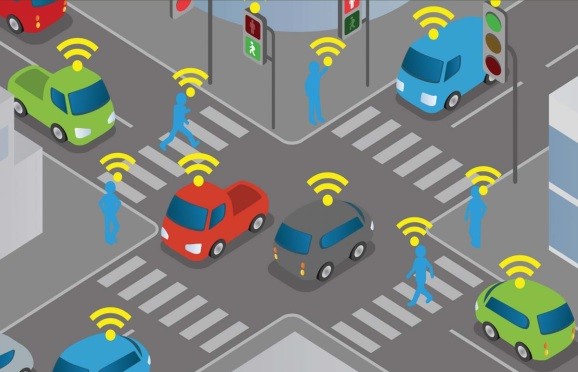
IoT is built on the idea of extending network connectivity beyond standard devices such as your laptops and smartphones to any traditionally non-internet-enabled (or “dumb”) device. There has been a prediction by Intel that there will be 200 billion of these connected objects or about 26 per human by next year. While the number seems huge, consider that 96% of companies that have thus far invested in the IoT space have seen a positive return on their investment, which implies that this trend will only continue to grow in near future.
Transportation is one of the sectors in which AI would be having far reaching transformation due to requirement of connectivity at all times. From optimizing navigation to safety to congestion to vehicle utilization, real-time latency-free data transfer will undoubtedly change the way we work and live. In recent years there has been more traffic jams, higher fuel prices, and an increase in CO2 emissions. Improvement in the safety and efficiency of transportation is of prime importance. It is of utmost importance to develop a sustainable intelligent transportation system and it requires the seamless integration and interoperability with emerging technologies such as connected vehicles, cloud computing, and the Internet of Things with real-time and historic traffic intelligence.
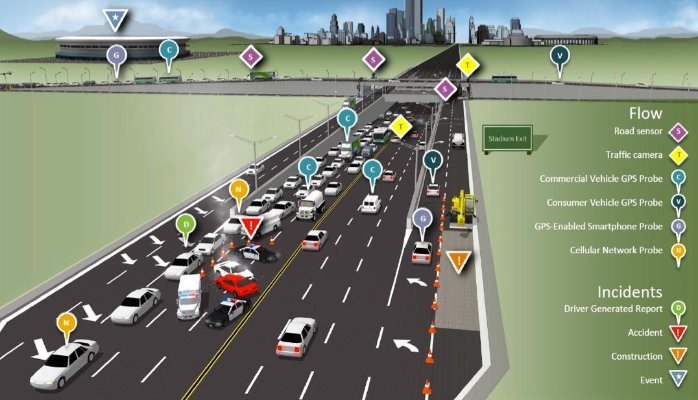
The future roads would be able to manage traffic congestion much better than today’s networks. In the next 20 to 30 years, the existing traffic system is expected to improve to such an extent that the cars would be used as data points to find major points of congestion and accordingly change the traffic suggestions for other cars to enable better traffic administration and manage traffic congestion without any human interaction at any point. Thus, travel would be smoother and safer. Sensors in cars would be used to track the cars at all points to find points of congestion and accordingly algorithms will help to find the best routes. This data would be sent wirelessly to a central control system, a hub which aggregates data to feed back the results to vehicles on the road. The system can use wireless sensors to obtain real-time traffic information, such as traffic condition on each road, number of vehicles, and average speed. Utilization of wireless sensors is optimal due to their low power consumption and low cost. This information can be sent to the control centre through satellite communication facilities. GPS along with the wireless sensor networks can be used for measuring driving speed and driving direction.
There can be a condition when there is a lot of traffic, then the central hub would relay information over the Wi-Fi which would then pass through the algorithm which would impose speed limits followed by vehicles that needs to be followed in the close by congestion area. There has been an estimation that if there is a successful implementation of smart transportation system, the money spent on traffic systems will get reduced by minimum 15%. It is fool proof against climatic changes as current image-based traffic technology which faces problem due to weather conditions.
Another implementation of IOT could be in the space of parking guidance. The drivers would be told over the Wi-Fi about the vacant spaces available near to their location removing the hassle of driving around the whole area looking for space.
The data flow via car sensors can ensure better navigation and traffic congestion. The drivers would be intimated with the shortest and best possible paths to reach their respective destinations so that carbon dioxide emissions can be controlled. This system can even warn the drivers about nearby school zones where there may be lots of children crossing the roads. The drivers can be alerted about nearby schools and alternative routes can also be suggested. In this technology the telecoms combine with Wi-Fi thereby producing better efficiency for the customers as well as the consumers both in the work place and even out of it.
The development of Electronic plate can be used for intelligent traffic monitoring for identifying and tracking the vehicle. E-Plate can be used as a transponder in license plate equipped with a E-Plate and sensors. Here every car gets data it needs from the spot and deliver the data to assigned destination. The vehicle E-Plate stores information about the vehicle and the owner. Parameters such as vehicle plate number, speed of the vehicle, license number, vehicle type, the travelling time of the car are stored and continuously monitored. This knowledge of information from every vehicle helps in estimating the number of vehicles on the road, the density of the vehicles on the road and average speed of the vehicles.
Safety
Nearly 1.2 million people die in road crashes each year with about 3,287 deaths a day on an average. Experts believe this number will be drastically decreased when self-driving vehicles start to replace human drivers. By equipping IoT-enabled cars with real-time driving, mapping, and video data, these smart vehicles will be able to see blind turns and corners from a distance, identify pedestrians, cyclists, and any other road hazards in advance, and make complicated split-second decisions to maximize human safety.
Smart traffic lights
The traffic lights of the future will change dynamically mirroring traffic flow, enabling faster commutes by 26%, reducing vehicle wait time by 40%, and reducing emissions by 21%.
Smarter movement of public transport
Public Transports like city buses can dynamically observe the number of people at a stop and can increase speed and reroute accordingly.
Conclusion
While any new technology is bound to have its own set of challenges which needs to be addressed, the benefits of an IoT enabled transportation system — increased public safety, traffic flow, fuel efficiency, and reduction of environmental impact — outweigh these challenges. It’ll be interesting to see how these technologies affect our cities, economies, and daily lives.